Nano Quantum Particle Accelerator
By Milo Thompson(2025)
Provisional Patent Application Exhibit 1
Table of Contents:
Theories and Formula
Hardware
Addendum I
Dirac’s Theory
Dirac equation is a relativistic wave equation derived by British physicist Paul Dirac in 1928. In its free form, or including electromagnetic interactions, it describes all spin-1/2 massive particles, called "Dirac particles", such as electrons and quarks for which parity is a symmetry. It is consistent with both the principles of quantum mechanics and the theory of special relativity,[1] and was the first theory to account fully for special relativity in the context of quantum mechanics. It was validated by accounting for the fine structure of the hydrogen spectrum in a completely rigorous way. It has become vital in the building of the Standard Model.[2]
Addendum II
Green’s Radial Theory
2] Hyperbolic Geometry and Harmonic Functions In this section we will re[state some basic facts about harmonic functions in terms of hyperbolic geometry. Our main goal is to prove Theorem 1.2. Let X denote a Riemann surface. We assume throughout this paper that X is connected and hyperbolic and has f initely generated fundamental group. Hence we can realize X as a subdomain of a compact, connected Riemann surface without boundary ˆ Xsuch that ˆ X\X isa finite union of isolated points (which we refer to as punctures) and closed, smoothly bounded, topological disks. When we write X and bX below, we mean closure with respect to ˆ X. Note that bX consists of all components of bX which are not punctures. By assumption, X is uniformized by the unit disk = {|z| < 1} ⊂ C. Therefore X inherits a hyperbolic metric with constant curvature −1 from the Poincar´e metric (2–1) ds = ds∆ = 2|dz| 1 −|z|2 on . We will also use ds to denote the hyperbolic length element on X. If η is a section of some tensor bundle on X, we let η(p) denote the hyperbolic length of η at p. Given K ⊂X we let BK(r) denote the set of points whose hyperbolic distance from K is less than r.
GREEN’S FUNCTIONS AND HYPERBOLIC GEOMETRY
5 In computations below we will need to use the specific form of the hyperbolic metric on the upper half plane H = {Imz > 0}: (2–2) ds = dsH = |dz| Imz ; on the annulus A = AR = {eR > |z| > e−R}: (2–3) ds = dsR = π|dz| 2|z|Rcos πlog|z| and on the punctured disk ∗ = {0 < |z| < 1}: (2–4) ds = ds∗ = −|dz| |z| log |z| . ; 2R We will make abundant use of the fact that the unit circle is a geodesic of length π2/R with respect to the hyperbolic metric on AR. We let inj(p) denote the injectivity radius of X at p; that is, inj(p) is the largest number t such that Bp(t) is a topological disk. Equivalently, if πp : → X is a uniformizing map sending 0 to p, then one can apply (2–1) to see that πp : {|z| < tanh(t/2)} → Bp(t) is an injection for t ≤ inj(p) but not for t > inj(p). We refer to the restriction of πp to the disk {|z| < tanh(1 2 inj(p))} as standard coordinates about p. We now turn to harmonic functions h on X. The first result we state appears in [Ah] (see chapter 4, sections 6.1 and 6.2) in the case of plane domains containing round annuli, but the proof generalizes perfectly well to a larger setting. Given a smooth function h on X, we let ∗dh denote the conjugate differential of h. Theorem 2.1: Circular Averages. Let h : X → R be a harmonic function. Let γ be a union of smooth, oriented closed curves. Then the quantity α(γ,h) def = 1 2π γ ∗dh, depends only on h and the homology class of γ in X. If f : AR → X is a holomorphic map and b ⊂AR is given the usual counterclockwise orientation, then there is a constant β ∈R such that 1 2π 2π 0 h◦f(reiθ)dθ = α(f∗b ,h)logr +β. holds for every r between e−R and eR. This result plays an absolutely crucial role in the proof of Theorem 1.1. In particular, we will use it in the next section to approximate Green’s function on an annulus. On more general Riemann surfaces, we will use it to estimate the amount by which Green’s function changes across a tubular neighborhood (the collar) of a short geodesic. Item (1) in the next result is simply a restatement of Harnack’s inequality for positive harmonic functions. Item (2) generalizes (1) to the case where h is bounded above and below, and item (3) to the case where h is harmonic and positive on only part of X
—-----------------------------------------------------------------------------------------------
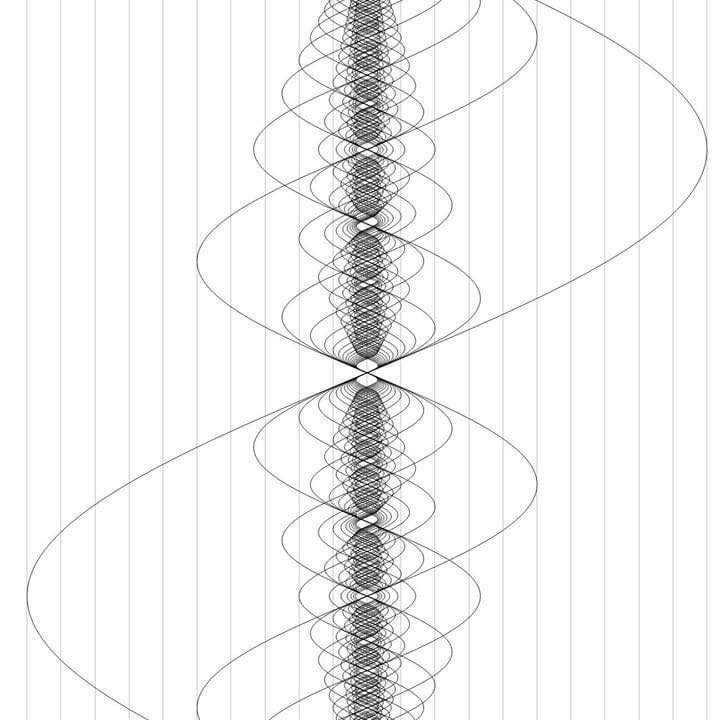
This is visual of harmonics of toroidal plasma field when magnetism interacts with harmonic resonance
Fitting Together The Pieces
=================================
Hardware
—------------------------------------------------------
Thesis and Scientific Usage
These experiments could pioneer a new class of vacuum-engineered quantum devices, unlocking on-chip particle acceleration, ultrafast quantum sensors, and entirely new computational and communication paradigms.
Coupled with the MILO nano quantum accelerator, they lay the groundwork for compact high-precision accelerators, vacuum fluctuation–based energy transducers, and next-generation quantum information processors.
1. Vacuum-Engineered Quantum Devices
● Controlled coupling to vacuum fluctuations
○ Enables vacuum-fluctuation transistors that switch via engineered ringdown anomalies.
○ Lays the foundation for zero-point energy harvesting concepts and extreme-precision force sensors.
● Planck-scale threshold sensing
○ Ultra-sensitive detectors for dark matter or exotic particles that modify the ringdown signature.
○ Tabletop testbeds for quantum gravity effects, potentially informing spacecraft-grade inertial guidance.
2. On-Chip Particle Acceleration & Quantum Simulators
● MILO nano quantum accelerator integration
○ Combines photonic resonators with nanostructured accelerating sections to boost electrons to keV–MeV energies on a chip.
○ Permits lab-scale free-electron lasers for coherent XUV/soft-X-ray sources.
● Quantum simulation of high-field physics
○ Emulate strong-field QED processes via electron-photon ringdown interactions.
○ Simulate particle creation and vacuum polarization in condensed-matter analogues.
3. Ultrafast Quantum Sensing & Metrology
● Attosecond-to-zeptosecond timing
○ Exploit cavity ringdown shifts to measure time intervals beyond optical-pulse resolution.
○ Build next-gen atomic clocks referencing vacuum-engineered resonators.
● Force and displacement sensors
○ Sensitivity reaching 10⁻²⁴ N via enhanced Q and vacuum coupling.
○ Applications in gravimetry, seismology, and biological force microscopy.
4. Novel Computational & Communication Architectures
● Vacuum-state qubits
○ Encode information in engineered zero-point modes of the resonator.
○ Fault-tolerant gates driven by electron-beam pulses.
● Secure quantum links
○ Vacuum-mediated entanglement between distant photonic chips.
○ Intrinsic immunity to eavesdropping by monitoring ringdown perturbations.
5. Materials Discovery & High-Energy-Density Physics
● Extreme field conditions
○ Use on-chip accelerators to explore new high-pressure phase transitions.
○ Synthesize exotic matter (metallic hydrogen analogues) via electron-beam lithography under vacuum stresses.
● Tabletop particle physics
○ Search for beyond-Standard-Model signatures (axions, dark photons) through ringdown anomalies.
○ Democratize high-energy experiments outside large facilities. Synergies with MILO Nano Quantum Accelerator
● Monolithic integration
○ Fusing photonic microrings and nano-accelerating structures in a single chip
○ Drastically reduces system footprint and power consumption.
● Scalable fabrication
○ Leverage semiconductor processes to mass-produce quantum accelerators and vacuum-engineered resonators.
● Programmable vacuum landscapes
○ Tailor local density of states to route electrons, photons, and phonons in reconfigurable circuits. Next-Level Divergent Directions
● Vacuum-based energy storage: prototype “zero-point capacitors” storing field energy with negligible leakage.
● Hybrid quantum-classical processors that offload nonlinear tasks to vacuum-engineered analog co-processors.
● Deployable quantum sensors for spacecraft navigation, using ringdown drift as an inertial reference.
● Consumer applications: ultrafast electron-beam lithography tools for sub-10 nm semiconductor fabrication.
● Roadmap development: timeline, cost estimates, and industrial partnerships for a pilot MILO-resonator foundry.
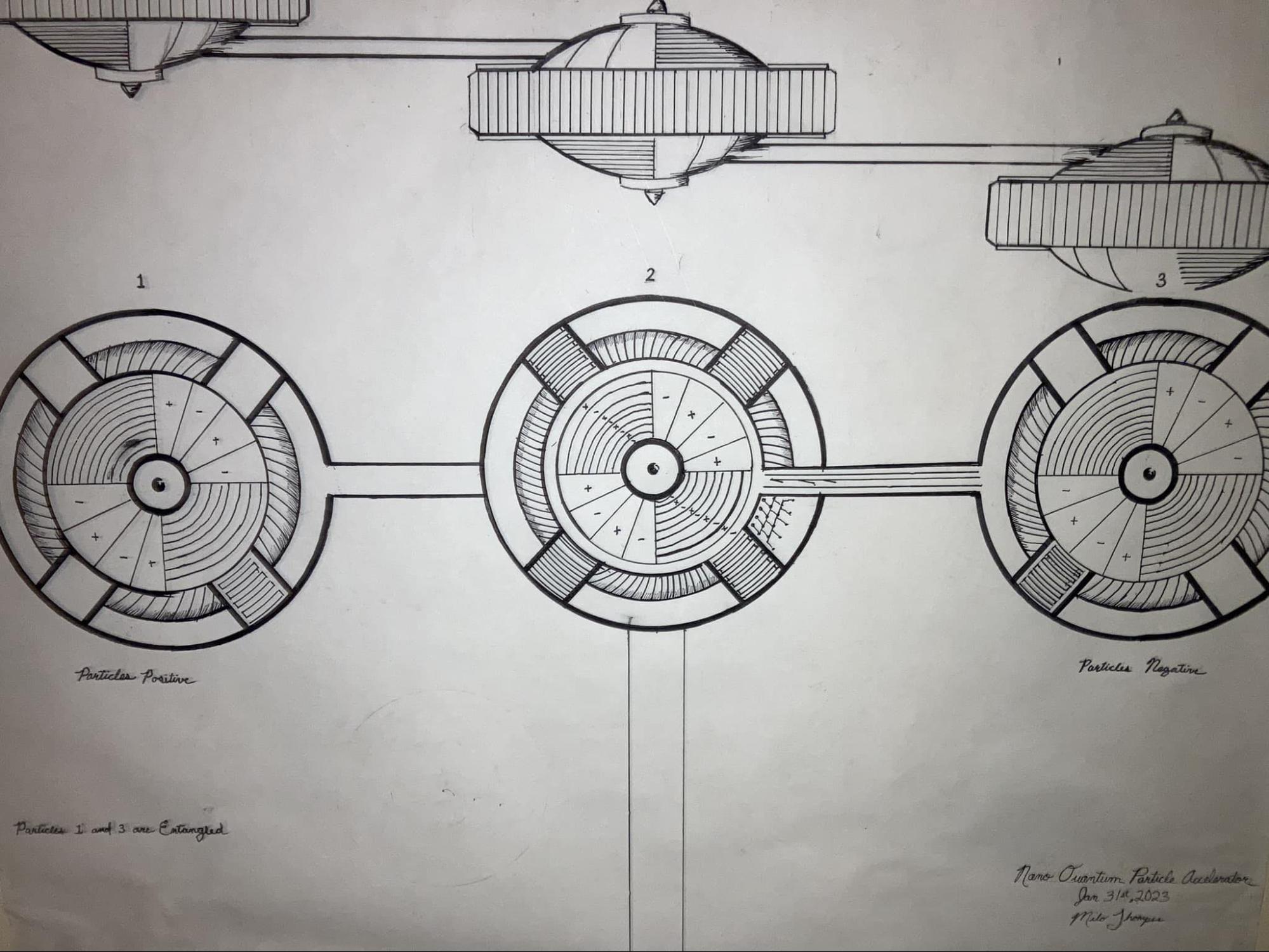
Exhibit A: 2023 Source Auto Shell Sketch of Accelerator 41:1 scale on 1 cm notation in size
Formulas and Testing
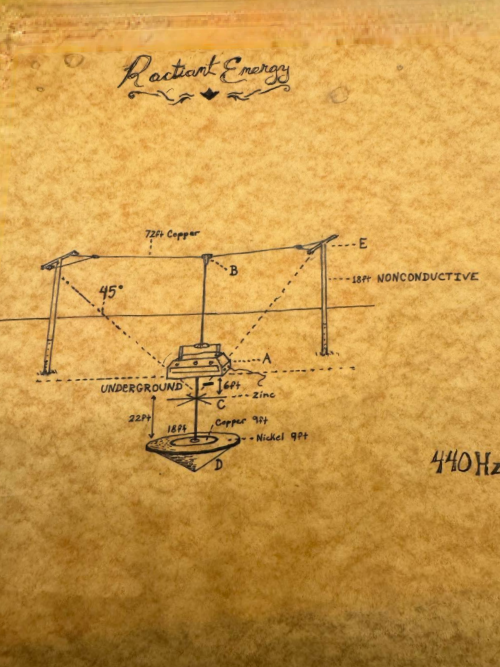
+5000x SCALE TESTING APPARATUS BASED ON T.H Moray Designs
Thomas Henry Moray Macro Build
Citations
Dirac’s Theory: Addendum I : Wikipedia : Dirac equation - Wikipedia
Green’s Radial: Addendum II: University of Notre Dame - Jeffrey Diller
Applications and Testing
Harnessing the vacuum’s zero-point field as an energy reservoir demands melding quantum electrodynamics with precision nanofabrication. Below is a conceptual blueprint and R&D pathway for a vacuum-gap capacitor that stores and releases energy by engineering and “pumping” vacuum modes.
Component | Material/Process | Key Specs |
Electrodes | Niobium thin film (100 nm) | Tc ≈ 9 K, RRR > 50 |
Spacers | SiO₂ nanopillars (50 nm height) | Litho-defined, ±2 nm uniform |
Cavity Mirrors | Bragg multilayers (Nb₂O₅/SiO₂) | Reflectivity > 99.99% |
Substrate & Seals | Silicon wafer with ALD-SiO₂ passivation | UHV compatible |
ρ(ω) ∝ ω² → concentrate on GHz–THz band for maximal ½ℏω per mode
UZPE≈∑ωi12ℏωi∼10−6 − 10−4 Jcm3U_{\rm ZPE} \approx \sum_{\omega_i}\tfrac12\hbar\omega_i \sim 10^{-6}\!-\!10^{-4}\,\tfrac{\rm J}{\rm cm^3}
UZPE ≈ ∑ωi ½ℏωi ∼ 10⁻⁶–10⁻⁴ J/cm³
(orders of magnitude below chemical batteries but with near-zero self-discharge)
Thesis and Formula
Milo’s vision of a handheld “nano” quantum accelerator—essentially a compact QPU co-processor—rests on a trajectory that’s actively being pursued in both academia and industry. The notion of embedding a small-scale quantum accelerator alongside classical hardware, much like a GPU or FPGA today, has been proposed as a way to offload specialized tasks (e.g., optimization, signal processing) to quantum resources without relying on remote quantum cloud services.
However, current quantum hardware remains in its infancy. Available systems offer only tens of noisy qubits, struggle with decoherence, and require complex cryogenics or shielding. Even simulating modest quantum circuits demands vast classical resources, underscoring that miniaturizing and stabilizing a full-blown quantum processor into a palm-sized device represents a formidable engineering challenge. That said, room-temperature diamond-NV devices and other solid-state platforms are paving the way for truly portable quantum modules.
Companies like Quantum Brilliance are already prototyping diamond-based quantum accelerators designed to slot into standard data-center racks or edge-devices, targeting signal and image processing at the network edge rather than universal quantum computation. In practice, Milo’s nano accelerator concept is viable—provided it’s aimed at niche, noise-tolerant applications (quantum sensing, certain optimization heuristics) rather than fault-tolerant, large-scale algorithms.
Achieving reliable, scalable performance will demand breakthroughs in error correction, materials science, and control electronics. But as a specialized co-processor for targeted tasks, a “nano” quantum accelerator is well within the realm of near-term R&D.
[a]Exhibit A